
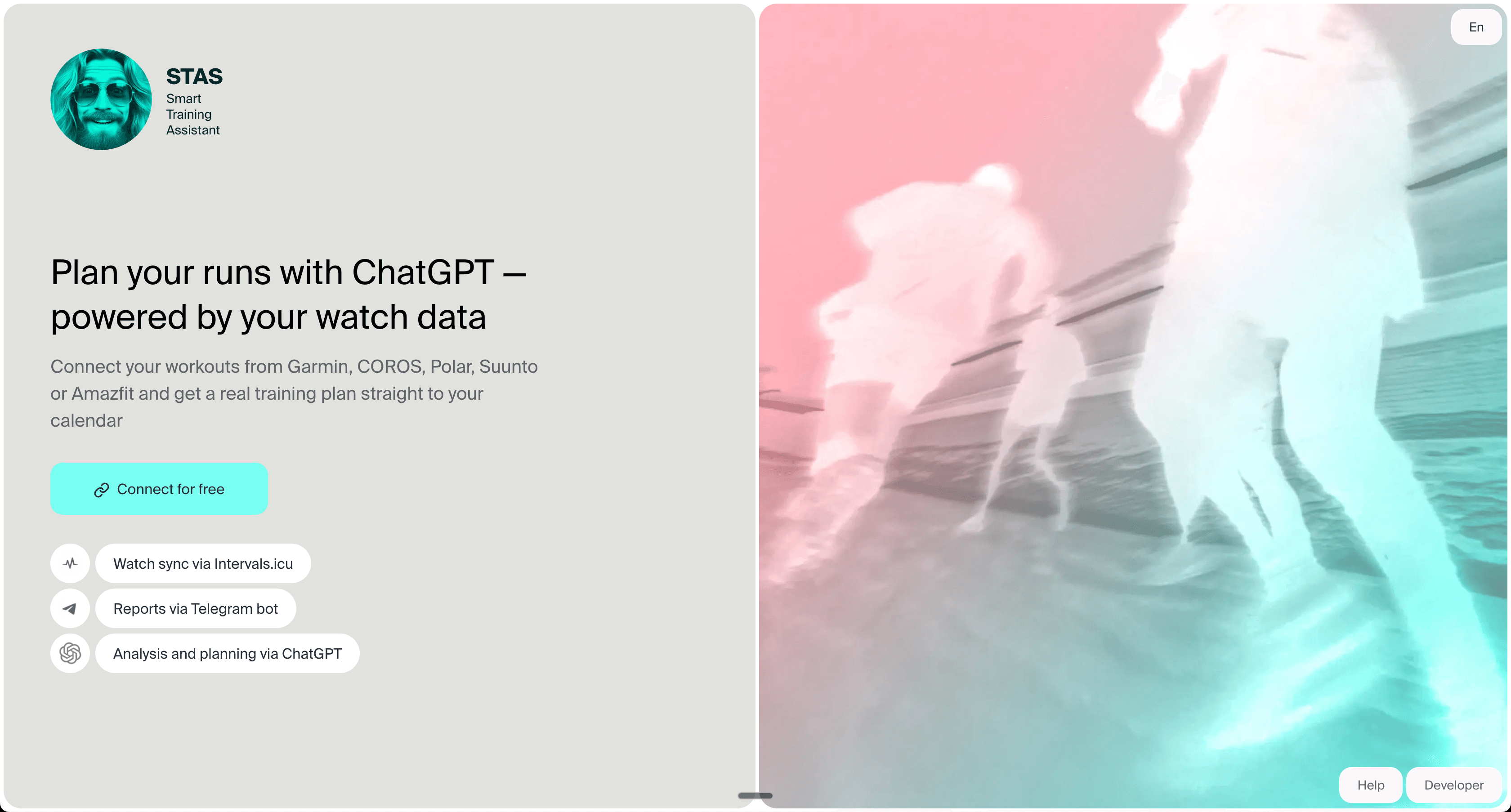
Product entry point
The website explains the connection between Intervals.icu, STAS, ChatGPT, and Claude.
Static asset: /images/search-growth/intervals-ai-coach-home.png
Press and reviewer kit
STAS is a practical AI coaching layer for endurance athletes who already collect training data in Intervals.icu. It helps ChatGPT or Claude answer from real workouts, load, fatigue, calendar context, goals, and saved rules.
Try STAS with Intervals.icu dataSee product screenshotsSTAS is not a new watch app and not a closed training-plan generator. It sits between Intervals.icu and AI chat, preparing the data an athlete would otherwise have to copy, summarize, or screenshot by hand.
The product uses Intervals.icu as the source of truth, then gives AI enough context to discuss training decisions in normal language.
Garmin, Suunto, Polar, COROS, Huawei, Amazfit, Apple Watch, and other sources can sync training into Intervals.icu.
Workouts, calendar, load, fatigue, form, zones, wellness, and history stay in the athlete's Intervals.icu account.
STAS prepares recent workouts, current condition, sport context, goals, rules, and plan context for AI use.
The athlete asks for review, explanations, safer alternatives, weekly planning, or plan rewrites.
The strongest early fit is an endurance athlete who has real training history and wants AI to reason from that history instead of giving generic advice.
Athletes who already use Intervals.icu for analysis, fitness/fatigue tracking, and calendar planning.
People who want help reviewing training, but still want to understand and approve plan changes.
Useful when travel, stress, missed workouts, soreness, strength work, or poor sleep changes the plan.
A compact example of AI coaching that uses real training data rather than a standalone chatbot prompt.
These are the kinds of questions STAS is built to support once Intervals.icu is connected.
Is this athlete fresh, overloaded, rebuilding, or ready for intensity this week?
Was the session really easy, too hard, or different from the planned intent?
How should the next 7-10 days change after a missed session, fatigue spike, or race priority?
Why is this workout recommended, and what is the safer alternative if recovery looks poor?
STAS does not train a separate personal model from private data. It fetches and prepares the athlete's current training context so ChatGPT or Claude can reason from it during the session.
Recent workouts, sport type, duration, intensity, pace, power, heart rate, and structured workout details where available.
Fitness, fatigue, form, weekly history, calendar context, zones, and wellness or recovery signals when Intervals.icu has them.
Profile, goals, rules, current condition, strategy, and sport-specific summaries are shaped into context the AI can use.
The AI can discuss a plan rewrite and, when the user chooses, STAS can help write planned sessions back to Intervals.icu.
These screenshots are already available as public assets and show the real product flow rather than mock launch messaging.
The website explains the connection between Intervals.icu, STAS, ChatGPT, and Claude.
Static asset: /images/search-growth/intervals-ai-coach-home.png
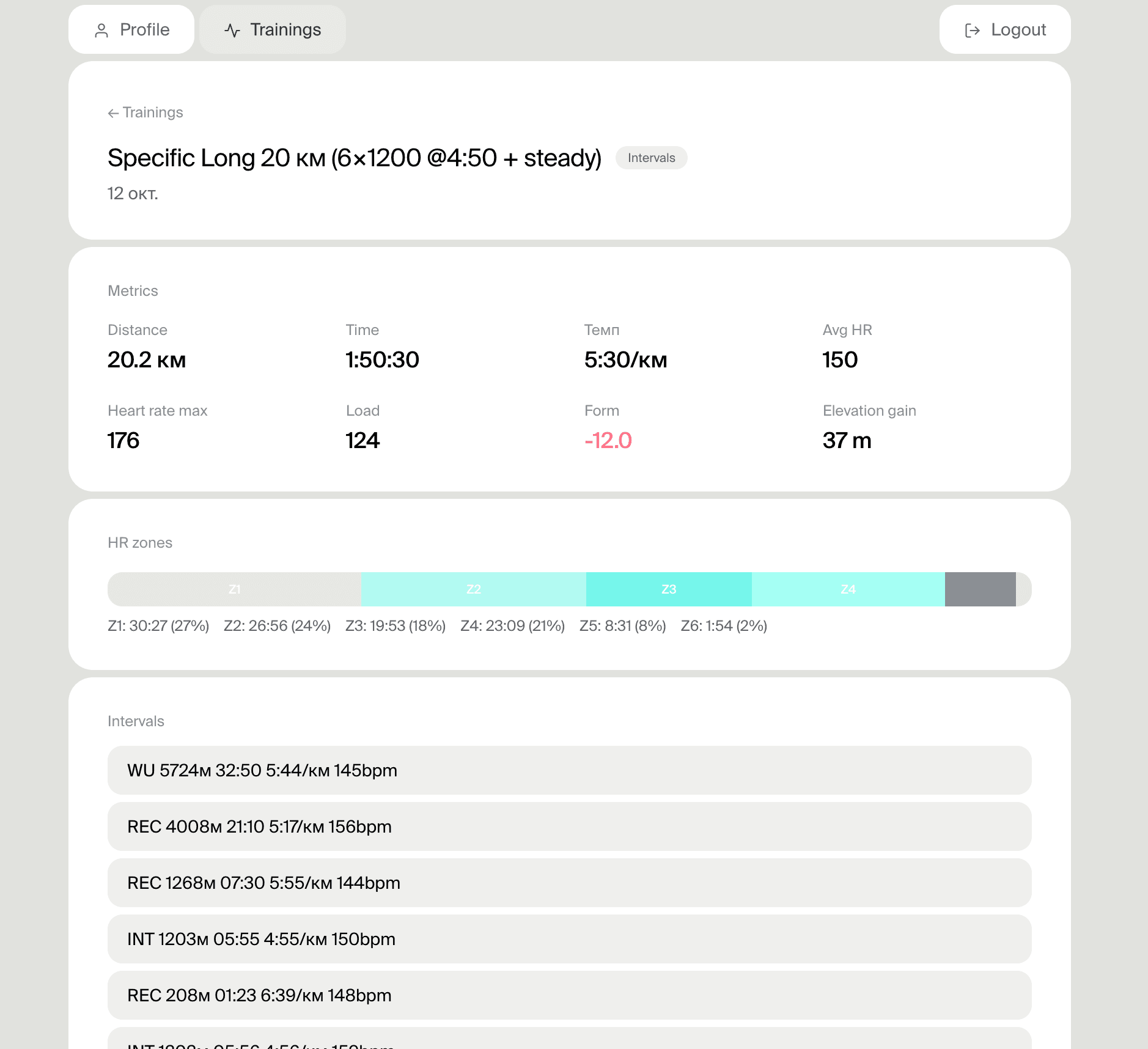
Training details show the kind of real workout data that supports coaching answers.
Static asset: /images/search-growth/intervals-ai-coach-training-detail.png
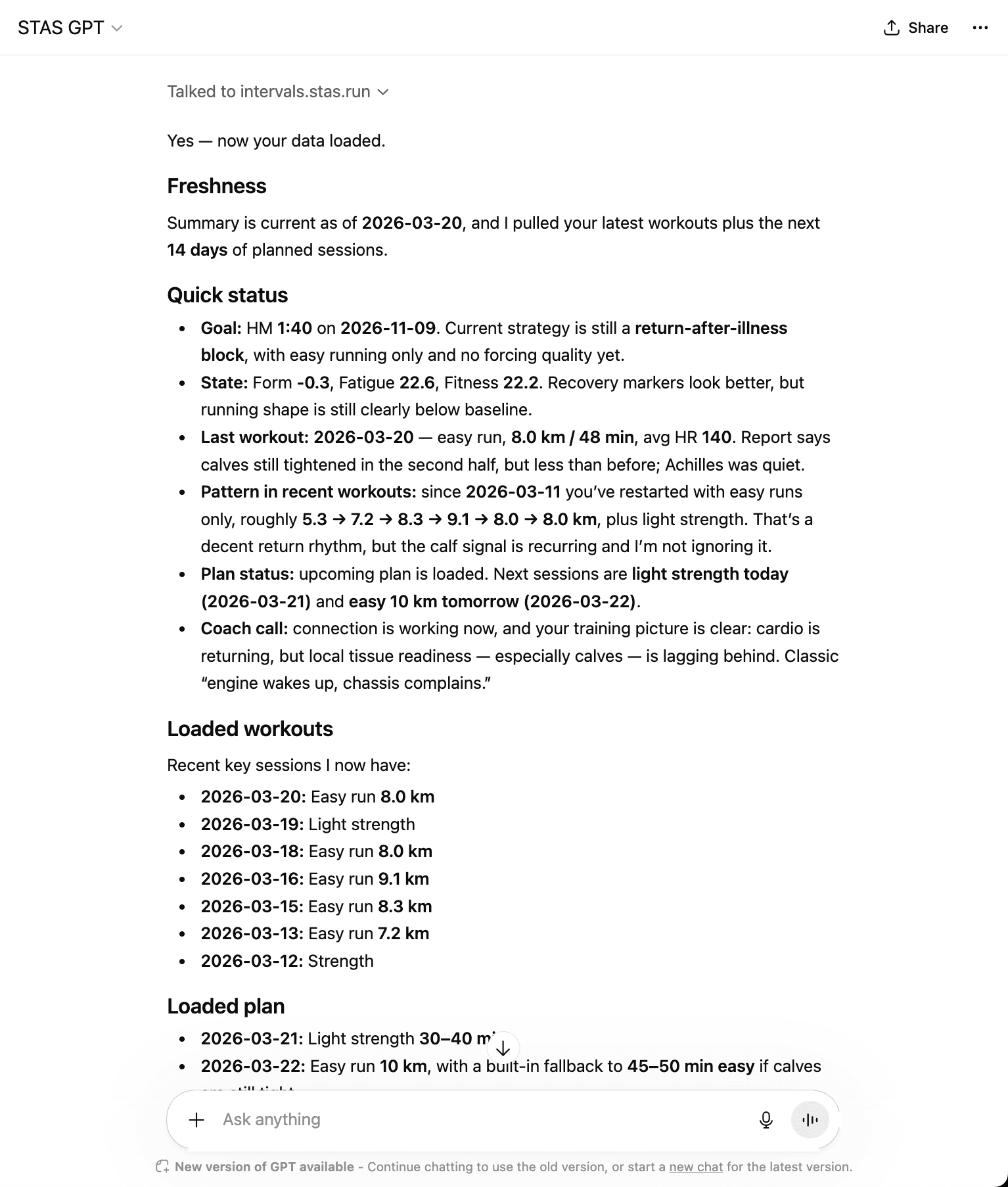
The AI conversation can start from prepared training context instead of pasted screenshots.
Static asset: /images/search-growth/chatgpt-real-training-context.png
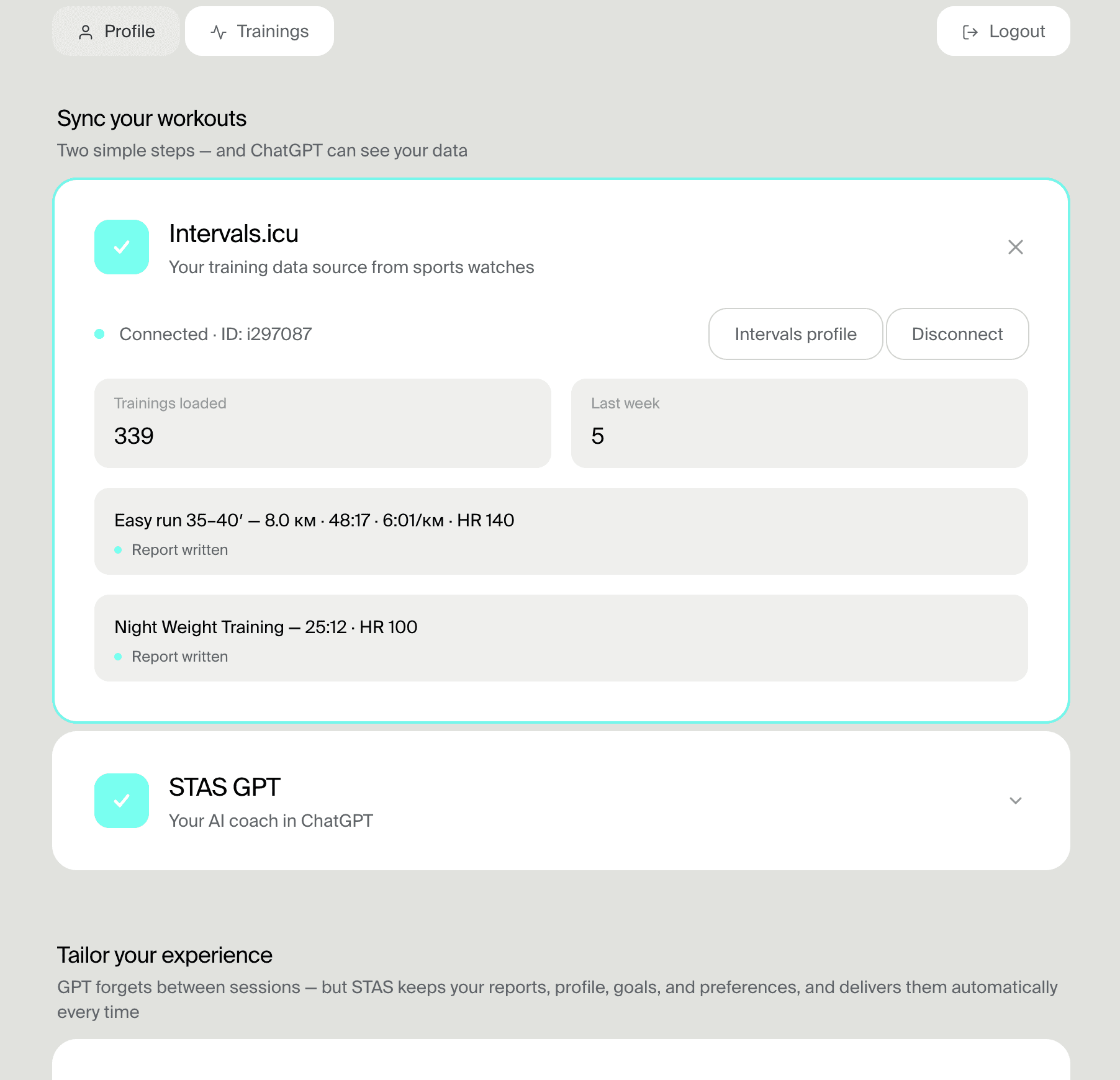
The setup path is centered on connecting Intervals.icu data and then using an AI channel.
Static asset: /images/search-growth/chatgpt-onboarding-connections.png
Start with the four linked pages below: they explain the Intervals.icu data flow, ChatGPT use case, Amazfit HR-zone checks, and Zepp Coach context.
Use the public proof assets on this page for a quick visual understanding of setup, training data, and AI coaching context.
The practical test is connecting Intervals.icu and asking about current condition, a workout review, or a short plan rewrite.
STAS supports training decisions. It is not medical advice, not emergency guidance, and not a substitute for a human coach when the situation requires one.
STAS depends on existing training data sources and Intervals.icu rather than replacing the athlete's watch ecosystem.
The difference is data access: recent workouts, load, zones, calendar, goals, and rules can be available in the conversation.
Plan changes are intentionally discussable. The athlete can ask why, choose a safer option, and approve what changes.
STAS needs permission to read Intervals.icu data so it can prepare useful coaching context. The athlete remains in control of account connection and training decisions.
Not primarily. STAS is a data bridge and coaching context layer for ChatGPT and Claude. It can help discuss or write plans, but the main value is AI seeing real Intervals.icu data.
Yes for the core product promise. Intervals.icu is the data layer that keeps workouts, load, zones, calendar, and history together.
The product is strongest for endurance workflows: running, cycling, triathlon, and mixed weeks that include strength or other activity.
Connect Intervals.icu data and ask about current condition, one recent workout, and whether the next week should change.
The main explanation of STAS as an AI coaching layer on top of Intervals.icu.
A practical page showing why ChatGPT needs real workout and plan context.
A concrete proof path around heart-rate zones, Intervals.icu history, and STAS interpretation.
A balanced guide on Zepp Coach, load checks, and when to review broader training history.
Connect Intervals.icu data, then ask STAS through ChatGPT or Claude about a recent workout, current condition, or the next week.
Try STAS with Intervals.icu dataFree STAS account. Intervals.icu connection is required for the real data workflow.