
Strength training for triathletes: how to fit it into a swim, bike and run week
Strength training for triathletes is less about the exercises than about the calendar. You already train three sports, and most weeks have little room left. Yet research on runners and cyclists suggests that strength training can help you use less energy at a given pace or power and improve time-trial performance.
This guide covers what the research says, how often to lift and which exercises to choose, two ready-made workouts, how to adjust your lifting from the off-season to race week, and how to plan your sessions in ChatGPT or Claude. Along the way, we follow one athlete: a triathlete with a half-distance race in 16 weeks, three swims, three rides and three runs a week, and Monday and Wednesday evenings free for the gym.
Quick answer
- Two strength sessions a week in the off-season and one shorter session in race season is a common setup.
- Once you’re comfortable with the lifts, use heavier weights for low-rep leg exercises. The shorter workout below adds upper-body pulls and core work.
- Keep heavy leg sessions away from key bike and run workouts. If you lift and do endurance training on the same day, start with the workout that matters most.
- Connected through STAS, your AI chat can see your swims, rides, runs and logged sets and suggest where strength fits.
Why triathletes lift: what the research shows
Triathlon is long, steady work, so it’s tempting to think the gym has little to offer. The reviews suggest otherwise. Strength training can improve economy, which means using less energy at the same pace or power, and it can improve time-trial performance. For runners, both heavy lifting and explosive exercises showed potential benefits; for cyclists, the strongest evidence favored heavy lifting.
The performance findings here apply most directly to running and cycling. Whether the same exercises improve your swim split or your overall triathlon time is a separate question, so treat the research as a guide for the bike and run.
| Study | Design and participants | What it found |
|---|---|---|
| Beattie et al., 2014 | Review of 26 studies, endurance athletes | Some studies found better economy and faster time trials after strength training. |
| Rønnestad and Mujika, 2014 | Review, runners and cyclists | Heavy or explosive exercises could improve running performance; for cycling, the strongest evidence favored heavy lifting. |
| Blagrove et al., 2018 | Review of 24 studies, runners | Running economy often improved by about 2–8%. Most of the studies that found improvements used 2–3 strength sessions a week. |
| Schumann et al., 2022 | Meta-analysis, concurrent strength and endurance training | Similar gains in maximal strength and muscle size with or without endurance training. Gains in explosive strength were smaller than with lifting alone; the difference was clearest when lifting and endurance work were done in the same session. |
| Eddens et al., 2018 | Meta-analysis, exercise order within one session | Lifting before endurance work in the same session for several weeks led to bigger gains in dynamic leg strength; no clear difference in maximal aerobic capacity. |
Heavy weights or strength endurance?
Some triathlon plans use light weights and high reps to build muscular endurance. Others use the gym to build strength, on the grounds that swimming, cycling and running already build endurance.
Reviews found that heavy or explosive strength work could help runners; for cyclists, the strongest evidence favored heavy lifting. Lifting can build some muscle even alongside endurance training, but with a triathlon training load, big gains in size are unlikely, and body weight depends much more on what you eat and how much you train overall. This guide’s starting point is 3–6 reps per set on the main lifts, with a weight that leaves about two reps in reserve, after a few weeks of learning the movements with lighter loads.
How strength fits a three-sport week
The hard part isn’t the gym session itself. It’s placing it so it doesn’t take the edge off the workouts that matter most.
A sample triathlon week with strength
Here is the week our half-distance athlete starts with in the off-season. Your days will differ; what matters is where the heavy leg session sits.
| Day | Swim, bike, run | Strength |
|---|---|---|
| Mon | Easy swim, 45 min, plus a short easy run | Workout B: pulling and core |
| Tue | Morning bike intervals (key), easy swim later | — |
| Wed | Easy run, 40 min | Workout A: heavy legs, Wednesday evening after the run |
| Thu | Swim with harder sets | — |
| Fri | Short easy spin | — |
| Sat | Long ride, Saturday morning (key) | — |
| Sun | Long run (key) | — |
In this example, Wednesday evening’s heavy leg session comes about a day and a half after Tuesday morning’s intervals and more than two days before Saturday’s long ride. Monday’s session is light and mostly upper body and core.
Two ready-made strength workouts for triathletes
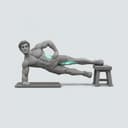
All exercises are in the STAS exercise library, with images. Start with light weights. On exercises counted in reps, finish each set feeling you could do two or three more with good form; for timed holds, stop if your form slips.
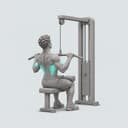
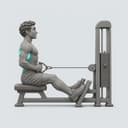
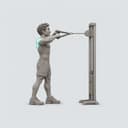
Workout A focuses on the legs and hips. Workout B is shorter and combines upper-body pulls with core exercises.
Workout A: heavy lifting for legs and hips
40–50 minutes, after an easy run or spin




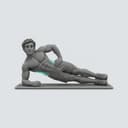
Workout B: pulling and core
25–30 minutes, light

How strength training changes through the season
Strength isn’t a fixed block you add once. Its role changes with the race calendar.
Planning it with your AI chat, step by step
Our athlete writes to Claude: “Add two strength sessions to my week. Half-distance race in 16 weeks. I can lift on Monday and Wednesday evenings.” Here’s how that plays out once their AI chat is connected through STAS.
Common mistakes
Prompts you can copy into ChatGPT or Claude
These work best once your AI chat is connected through STAS, because it can use your calendar, workouts and logged sets to tailor its answer.
Add two strength sessions to my week. My half-distance race is in 16 weeks. I can lift on Monday and Wednesday evenings. Look at my last four weeks of swimming, cycling, running and lifting. Is the gym getting in the way of my key sessions? Race season starts next month. Cut my strength work to one session a week and tell me what to keep. My main race is in two weeks. How should I handle strength training until then?
Who does what
Your AI chat reads your data
Your AI chat suggests, you decide
Approve the plan before it’s saved
Tell your AI chat how you feel
FAQ
Related guides
Plan your strength sessions around swim, bike and run
Sign in to STAS with Intervals.icu. Connect your own ChatGPT or Claude account through STAS, then ask your AI chat to fit strength sessions into your triathlon week.