
Strength training for cyclists: off-season and in season
In studies on trained cyclists, heavy strength training improved cycling economy and performance. Here’s what the research shows, plus a sample week, two strength workouts, and how to adjust strength training from the off-season to race season.
Quick answer
- Studies on cyclists primarily use heavy strength training: low reps with heavy weights.
- Typically two strength sessions a week in the off-season and one in season.
- Leave a day or two between heavy leg training and a key ride.
- With rides and strength training on one calendar, the total load on your legs is easy to see.
What the research shows
These reviews and meta-analyses cover trained cyclists and endurance athletes. Their findings apply to the groups studied and don’t guarantee the same results for every rider.
Stronger legs produce the same power with less effort. That means more left in the tank late in a long ride, and something in reserve for climbs and the final sprint. In studies on cyclists, this shows up as better cycling economy and faster time-trial results.
Heavy strength training worked best: a few reps with a heavy weight. Many cyclists worry that lifting will make them gain weight. This kind of training mainly builds strength; your body weight depends much more on what you eat and how much you train overall. There’s more on this in the FAQ below.
| Study | Who was studied | What it found |
|---|---|---|
| Rønnestad and Mujika, 2014 | Review, cyclists and runners | Heavy strength training worked best for cyclists. |
| Beattie et al., 2014 | Review of 26 studies, endurance athletes | Strength training improved economy and time-trial performance. |
| Schumann et al., 2022 | Meta-analysis, concurrent strength and endurance training | Gains in strength and muscle size were almost the same as without endurance training; gains in explosive strength could be smaller when both types of training took place in one session. |
| Eddens et al., 2018 | Meta-analysis, exercise order within a session | Lifting before endurance work led to bigger gains in leg strength; the order made no difference to endurance. |
A sample off-season week
Two key rides and two strength sessions. The heavy session comes after an easy ride and well away from the long ride.
The off-season is the best time for strength work: there are no races, and your legs have time to recover. The rule is the same as for runners: do heavy strength work on the same day as an easy ride, not the day before intervals or a long ride.
| Day | Ride | Strength |
|---|---|---|
| Mon | Rest | — |
| Tue | Intervals (key) | — |
| Wed | Easy ride, 60 min | Session A after the ride |
| Thu | Easy ride, 60–75 min | — |
| Fri | Rest | Session B or rest |
| Sat | Long ride (key) | — |
| Sun | Easy ride, 60 min | — |
If your key days fall elsewhere, keep the same rule: put the heavy session after an easy ride, never the day before intervals or a long ride.
Two sample strength workouts
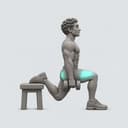
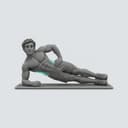
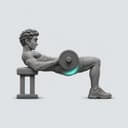
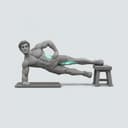
Every exercise is in the STAS exercise library, with images. Sets and reps are a starting point: begin with light weights and finish each set with 2–3 reps left in the tank.
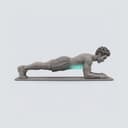
Workout A is the main one, for leg strength. Squats, deadlifts, split squats and step-ups work the same muscles that turn the pedals. Workout B is shorter and easier: your glutes and core hold your position on the bike once a ride stretches past the first hour.
Session A: heavy strength training for legs
45–60 minutes, after an easy ride



Session B: glutes and core
Light session, 25–30 minutes


How to adjust strength training through the season
The role of strength training changes from the off-season to racing.
Strength training changes with the season. In winter it builds strength, in spring intervals take priority, and in summer it helps you hold on to what you’ve built.
Common mistakes
The most common mistakes are badly timed strength sessions and dropping the gym for the whole season.
How to do this in STAS
With your rides and strength sessions on one calendar, you can see right away if a heavy strength session lands next to intervals.
Plan your week in your AI chat
One calendar
Log sets at the gym
Exercise history
Before you start
If you have an injury or pain, or haven’t done strength training in a while, start with light weights and check with your doctor.
FAQ
Related guides
Keep your riding and strength training on one calendar
Sign in to STAS with Intervals.icu and ask ChatGPT or Claude to add strength sessions around your key rides. It’s free to start, no credit card needed.