
Strength training for runners: how to fit it around your runs
In studies, trained runners who added 2–3 strength sessions a week improved their running economy and their performance over 1.5–10 km. Here’s what the research shows, plus a sample week, two strength workouts, and a plan for gradually increasing the training load without disrupting key runs.
Quick answer
- 2–3 strength sessions a week is a common setup in studies on runners.
- Leave a day or two between heavy leg work and a key run.
- If you run and lift on the same day, the order depends on your main goal.
- Before a race, runners usually continue strength training but reduce the load.
What the research shows
These reviews and meta-analyses cover trained runners and endurance athletes. Their findings apply to the groups studied and don’t guarantee the same results for every runner.
Every running stride is a push-off: your leg catches your body weight and drives it forward. The stronger your muscles and tendons, the less energy each push-off costs. Researchers call this running economy: at the same pace, you use less oxygen, so you can hold that pace longer.
What works best isn’t light dumbbells for lots of reps, but heavy lifts for 3–6 reps plus jumps. Many runners worry that lifting will leave their legs heavy and slow them down. Heavy legs do happen, especially in the first few weeks and the day after the gym. So the real question isn’t whether to lift, but where strength sessions go in your week.
| Study | Who was studied | What it found |
|---|---|---|
| Blagrove et al., 2018 | Review of 24 studies, runners | Running economy improved by 2–8%, and performance over 1.5–10 km improved. Most programs used 2–3 strength sessions a week. |
| Rønnestad and Mujika, 2014 | Review, runners and cyclists | Heavy and explosive exercises worked best. |
| Beattie et al., 2014 | Review of 26 studies, endurance athletes | Strength training improved economy and time-trial performance. |
| Wilson et al., 2012 | Meta-analysis of 21 studies | Combining strength and endurance training limited gains in explosive strength the most; the effect depended on running volume and frequency. |
| Schumann et al., 2022 | Meta-analysis, concurrent strength and endurance training | Gains in strength and muscle size were almost the same as without running; gains in explosive strength could be smaller when both types of training took place in one session. |
| Eddens et al., 2018 | Meta-analysis, exercise order within a session | Lifting before running led to bigger gains in leg strength; the order made no difference to endurance. |
A sample week
A training week for a 10K or half marathon: two key runs and two strength sessions. The heavy session comes after an easy run and well away from the long run.
The main rule is simple: keep hard days hard and easy days easy. Put leg strength work on the same day as an easy run, not on a free day between key sessions. That gives your legs a day or two to recover before intervals and the long run, and your rest day stays a rest day. If you run and lift on the same day and running is your priority, run first.
| Day | Run | Strength |
|---|---|---|
| Mon | Rest | — |
| Tue | Intervals (key) | — |
| Wed | Easy run, 40 min | Session A after the run |
| Thu | Easy run, 45 min | — |
| Fri | Rest | Session B or rest |
| Sat | Easy run, 40 min, with strides | — |
| Sun | Long run (key) | — |
If your key days fall elsewhere, keep the same rule: put the heavy session after an easy run, never the day before a key session or a long run.
Two sample strength workouts
Every exercise is in the STAS exercise library, with images. Sets and reps are a starting point: begin with light weights and finish each set with 2–3 reps left in the tank.
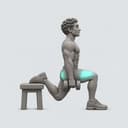
Workout A is the heavy one. Squats and Romanian deadlifts build your thighs and glutes, Bulgarian split squats load each leg on its own, just like running does, and your calves absorb the impact of every stride. Workout B is short: jumps train you to push off the ground quickly, and the core work keeps your pelvis stable when your form starts to fall apart late in a race.
Session A: heavy strength training for legs and core
40–50 minutes, after an easy run



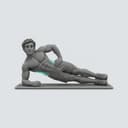
Session B: jumps and core
Light session, 25–30 minutes



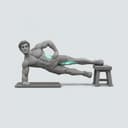

How to progress week by week
A plan for building up over a 10–12-week training block.
On the main lifts, add weight a little at a time. But running tires your legs too, so add weight more slowly than you would if you only lifted, and only once every set leaves you reps to spare. As race day gets closer, the goal changes: you’re no longer adding strength, just keeping what you’ve built.
Common mistakes
Almost every mistake comes down to two things: where strength sits in your week and how much weight you lift.
How to do this in STAS
With your runs and strength sessions on one calendar, you can see the one-to-two-day gap before a key session at a glance instead of keeping it in your head.
Plan your week in your AI chat
One calendar
Log sets at the gym
Exercise history
Before you start
If you have an injury or pain, or have not done strength training in a while, start with light weights and check with your doctor.
FAQ
Related guides
Plan your running and strength in one calendar
Sign in to STAS with Intervals.icu and ask ChatGPT or Claude to plan your week. It is free to start, no credit card needed.